
When words may not be enough: Using sand tray in therapy
By Guest author 28th May 2026


Training as a therapist after a career in medicine and science has not been without its challenges.
While I like to think my mind has broadened over the years, I was always searching for an elusive sweet spot — somewhere both parts of me could comfortably coexist.
So, when I was first invited to use creativity as a tool for self-reflection, my internal response involved a fair amount of eyerolling. It didn't feel like serious learning. It felt fluffy. Not very grown-up.
And then I was introduced to sand tray therapy.
My first experience of the sand tray
To my surprise, something shifted almost immediately.
Working with the sand and objects seemed to bypass my usual defences, leading me towards thoughts and feelings I had been skirting around for years. When I stopped trying to analyse everything and simply chose objects that felt right, things began to emerge clearly, almost without effort.
I remember thinking, where on earth is this coming from?
Curious, I trained further in the approach and began to understand why it worked so well for me. I had stumbled on the sweet spot I had been searching for.
Download our Nub News App!
- It’s FREE and available now- Breaking news notifications
- Your Town in Your Pocket


Sand tray therapy offered a meeting point between what made sense to me therapeutically and what I understood about the brain. It honoured both experience and evidence, feeling and science.
A simple way of understanding why it works
We experience and remember life in different ways.
Some memories are stored as stories — with words, explanations, logic, and sequence.
This is the part we use when we talk about our lives and try to make sense of them.
But we also store experiences in a more sensory and emotional way: through feelings, images, smells, sounds, and bodily sensations. Sometimes we feel something deeply before we can explain it logically.
When experiences become overwhelming, these systems can stop working together smoothly.
Instead of feeling like something is safely stored in the past, emotions and sensations can feel painfully present in the here and now.
This may show up as anxiety, sudden anger, emotional overwhelm, or feeling constantly on edge without fully understanding why.

It can feel a little like a filing system tipped upside down — papers everywhere, with no clear beginning, middle, or end.
What happens in the sand tray?
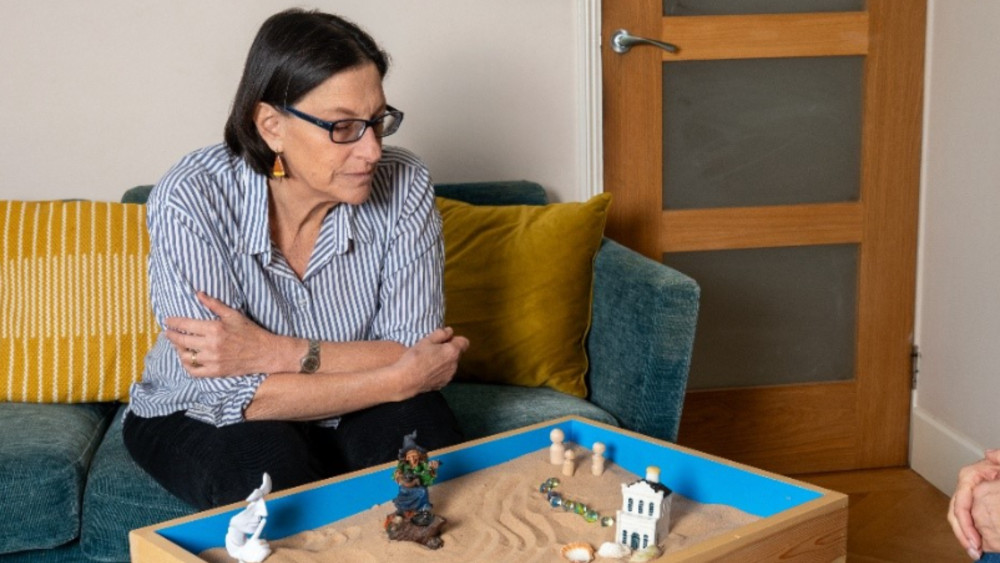
The sand tray itself is simple: a shallow tray of sand alongside a collection of miniature figures and objects.
Everything about the process is invitational. There is no right way to do it, no expectation to be artistic or imaginative, and no pressure to explain anything before you are ready.
Some people touch the sand because it feels calming and grounding. Some carefully choose symbols and place them deliberately.
Others pick objects without knowing why they are drawn to them. Some people create elaborate scenes; others place only one object — or none at all.
All of it is valid.
I often think about a client I'll call Robert, who had become stuck in talking therapy.
He felt there was something just out of reach emotionally, but he couldn't put it into words.

At first, he was sceptical about the sand tray, which is understandable. I gently encouraged him to worry less about "getting it right" and simply notice what drew his attention.
As he sat with the tray, he ran his fingers through the sand for a while, noticing its softness and texture, that he felt calmer as he did this.
Gradually he began placing objects into the tray one by one. Some he buried slightly. Others he moved repeatedly until they felt "right."
For my part, I sat quietly beside him and waited.
There is often something powerful about allowing the emotional, sensory part of the brain to lead for a while without immediately trying to analyse or explain everything.
Eventually, I invited Robert to talk me through what he had created. As we both looked at the tray together, words began to come more naturally. Connections appeared that had previously felt inaccessible.
What was once unspoken began to become spoken.
Sometimes this process brings clarity. Sometimes it simply creates curiosity. And sometimes nothing obvious emerges at all.

Sand tray therapy is not magic in the simplistic sense, nor is it a quick fix. But it can offer a different route into experiences that may feel difficult to reach through words alone.
Safety, choice, and trust
This kind of work can only happen in an environment of safety and trust.
Sand tray therapy can sometimes bring people close to powerful emotions or memories, so it matters enormously that the experience feels contained, paced, and free from judgement It matters that you are in control.
Meanings should never be imposed on someone else's symbols or creations.
Using the sand tray is always an invitation, never a requirement.
For some people, it becomes a deeply meaningful part of therapy.
For others, it simply doesn't fit — and that is completely fine too.
What it can offer
The sand tray can provide a gentle focus away from direct face-to-face conversation, allowing therapist and client to sit alongside each other rather than opposite one another and a 'third space' to look at things in.
It can create space for curiosity, reflection, emotional regulation, and sometimes even play — allowing logic and control to soften briefly while emotion and creativity are given room to speak.
And for me personally, it remains something rather special: a place where the scientific and the therapeutic parts of me learned to sit comfortably together.
A magic box.
The author, Deborah Lee Miller, is a Person-centred Pluralistic Therapist. If you would like to talk to anyone about anything raised in this blog, click here to find a therapist in Richmond at The Greenhouse Therapy Rooms.
The Greenhouse Therapy Rooms is a sponsor of Richmond Nub News, without our sponsors, our Richmond online newspaper would not be possible. Thank you.
Download our Nub News App:
- It’s FREE and available now
- Breaking news notifications
- Your Town in Your Pocket

Share: