Kew Gardens' Carbon Garden celebrates 'remarkable' first year
By Cesar Medina 10th Aug 2026
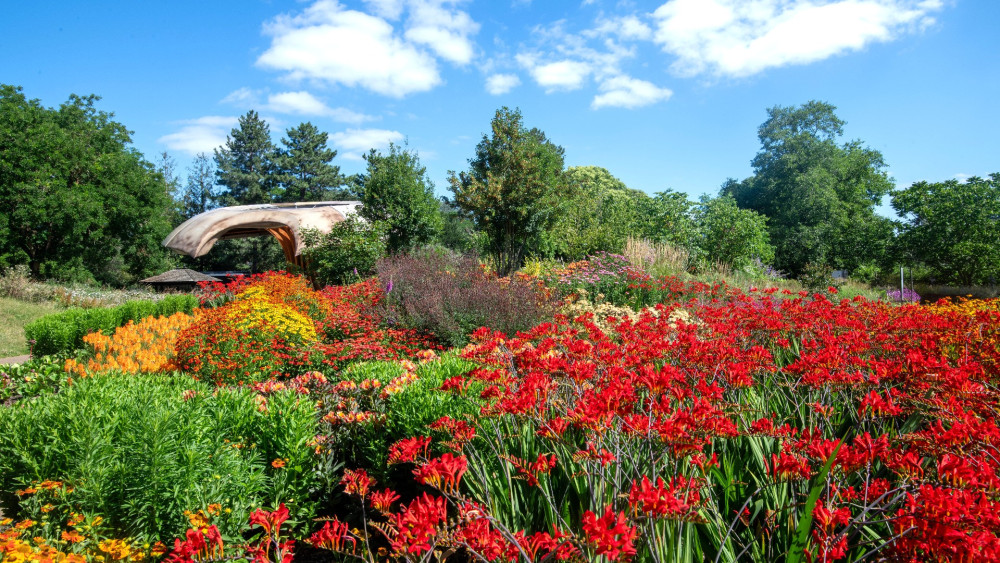


The Carbon Garden at Kew Gardens in Richmond Upon Thames is celebrating its first year since opening with a stunning array of colours and scents.
Inaugurated on 24 July 2025, the garden has come into full bloom with its 35 trees and more than 6,500 plants, all of which have been selected to weave a story about the scale of the climate crisis and the role plants and fungi play in responding to it.
Kew Gardens says the design and implementation reflect its "vital" mission to build a thriving planet for all, powered by plants and fungi.
Entering the garden, visitors are now met by a sea of colourful perennials inspired by Reading University's climate stripes, with shades of blue and purple (e.g. Echinops ritro 'Veitch's Blue', Salvia 'Mainacht') giving way to warm hues of red and orange (Crocosmia 'Lucifer' and Hemerocallis 'Stafford' amongst others), reflective of rising global temperatures.
Other immediate highlights include the bold yellows and reds of Achillea 'Moonshine', 'Paprika' and 'Red Velvet' as well as the violets of Hydrangea serrata 'Bluebird'.
In another section of the garden, an arid selection of drought-tolerant planting highlights species such as Parry's agave (Agave parryi), a perennial succulent known for its remarkable adaptation to dry climates and rocky environments with very little rainfall. Plants like these, Kew's horticulturists say, will play an increasingly important role in our future gardens as our climate continues to change.
Joe Richomme, Botanical Horticulturist whose team manages the Carbon Garden, said: "It's truly remarkable just how well the Carbon Garden has performed over the past year, with the planting now coming into full bloom.
"But even as we stand amidst these colourful flowers, especially in the context of the record-breaking heatwaves we witnessed this summer, we are reminded that London's climate is on track to resemble that of present-day Barcelona by the year 2050 and we need to be prepared to adapt to those changing conditions.
Download our Nub News App!
- It’s FREE and available now- Breaking news notifications
- Your Town in Your Pocket


"We hope that the work we do here in the Carbon Garden and behind the scenes at Kew will continue to teach and inspire people to adapt our landscapes to be better prepared for what awaits us."
Amongst the resilient trees overlooking the garden are specimens of Japanese elm (Zelkova serrata) and Persian ironwood (Parrotia persica), as well as:
- Honey locust (Gleditsia triacanthos)
- Oriental hornbeam (Carpinus orientalis)
- Judas tree (Cercis siliquastrum)
The 35 species in the garden have all been selected based on Kew's research detailed in Planting for the Future: Kew's Landscape Succession Plan, with consideration for their resilience to changing climate conditions.
Practical tips shared in the Carbon Garden by Kew's horticulturists include advice on climate-resilient plant selection, ways to garden without disrupting soil, meadow-establishment and how composting can help create carbon sinks in our backyards.
The goal of the Carbon Garden is to remind visitors that while climate challenge is global, meaningful action can begin locally says the UNESCO World Heritage Site.
READ MORE: Free book hunt for children comes to Richmond this week.
We want to provide Richmond with more and more clickbait-free local news. To do that, we need a loyal newsletter following. Help us survive and sign up for our free weekly newsletter by clicking the link HERE.
Download our Nub News App:
- It’s FREE and available now
- Breaking news notifications
- Your Town in Your Pocket


Share: